
Posted on August 27, 2026
The Big “Big Tent” Debate
Big tenters vs. exclusionists everywhere!
In his 2021 book Technology and the Historian, Adam Crymble explores the history of the perennial debate surrounding how exactly we should define the term “digital history,” and its closely related if not outright identical sibling “digital humanities.”1Crymble, Adam, Technology and the Historian: Transformations in the Digital Age (University of Illinois Press, 2021; online edn, Illinois Scholarship Online, 23 Sept. 2021), https://doi.org/10.5622/illinois/9780252043710.001.0001, accessed 12 Aug. 2026, 5-7. Crymble presents a framework of three models of digital humanities definitions:
- The “exclusive” model which attempts to gatekeep digital humanities to certain methods or signifiers of “real” digital history.
- The “big tent” model, which includes, broadly, anything which would like to call itself digital humanities or anything roughly involving a humanities study and a computer.
- Crymble’s own, preferred, “parallel streams” model, which contends that technology and historical studies have always evolved in parallel and interact with each other across many different intersections.2Crymble, Technology and the Historian, 163.
Crymble seems to make a strong enough case for his parallel streams model, but for our purposes, I’m not too interested in it. Even Crymble himself is not so interested in continuing this debate, and indeed, his model is as much a method of bypassing the debate in order to do scholarship on the subject as it is a cohesive definition.3Crymble, Technology and the Historian, 161. What I am interested in exploring is how the divide in mindset of the “big tenters” and “exclusionists” permeates throughout other aspects of digital history.
In the introduction, Crymble cites a running open survey done by the Day of Digital Humanities event, in which participants were asked to define what they thought digital humanities meant. Thanks to the University of Alberta’s archive, we can see these responses in raw form.4“How Do You Define Humanities Computing / Digital Humanities?” University of Alberta Archive. Accessed August 27, 2026. https://archive.artsrn.ualberta.ca/day-of-dh/define-dh.html. The responses are a fascinating snapshot:
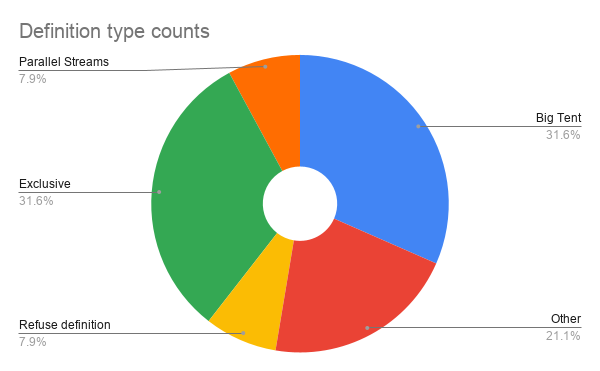
A few observations about this: for one, while a few offered a definition akin to Crymble’s “parallel streams” model, an equivalent number outright refused to answer the question. Additionally, a solid fifth of the respondents offered a definition which I could not neatly fit into any of Crymble’s boxes. Most importantly though, it visualizes for us the divide between “big tenters” and “exclusionists” as the primary division at play.
What I find interesting about this divide is the extent to which it serves as a proxy as a debate between two competing views which have reach into digital humanities beyond simply defining the subject, wherein they also serve as a philosophical boundary in how we construe the purpose of technology in our studies. On the one hand, the exclusionists represent a traditionalist, even formalist view, where academics represent a long tradition of study and formal principles from the Ivory Tower which must be upheld. On the other, “big tenters” represent an approach that is practicalist, with the purpose of academia being a no-holds-barred fight for knowledge. From this principle, the big tent principle of definitions of digital humanities based on self-identification follows naturally.
This divide pervades more widely than simply the precise definition of digital humanities. As an example, let me lay out a hypothetical for you. You have gone to do research at an archive, and they told you that not only were you free to take pictures of the sources you were using, but copyright was no issue, and there were no legal barriers to posting such sources online. Furthermore, everyone involved was long dead, and there was therefore no risk of putting someone in danger by making these documents more accessible. Would it therefore be correct, to post these sources online and provide a links to these sources in your citations?
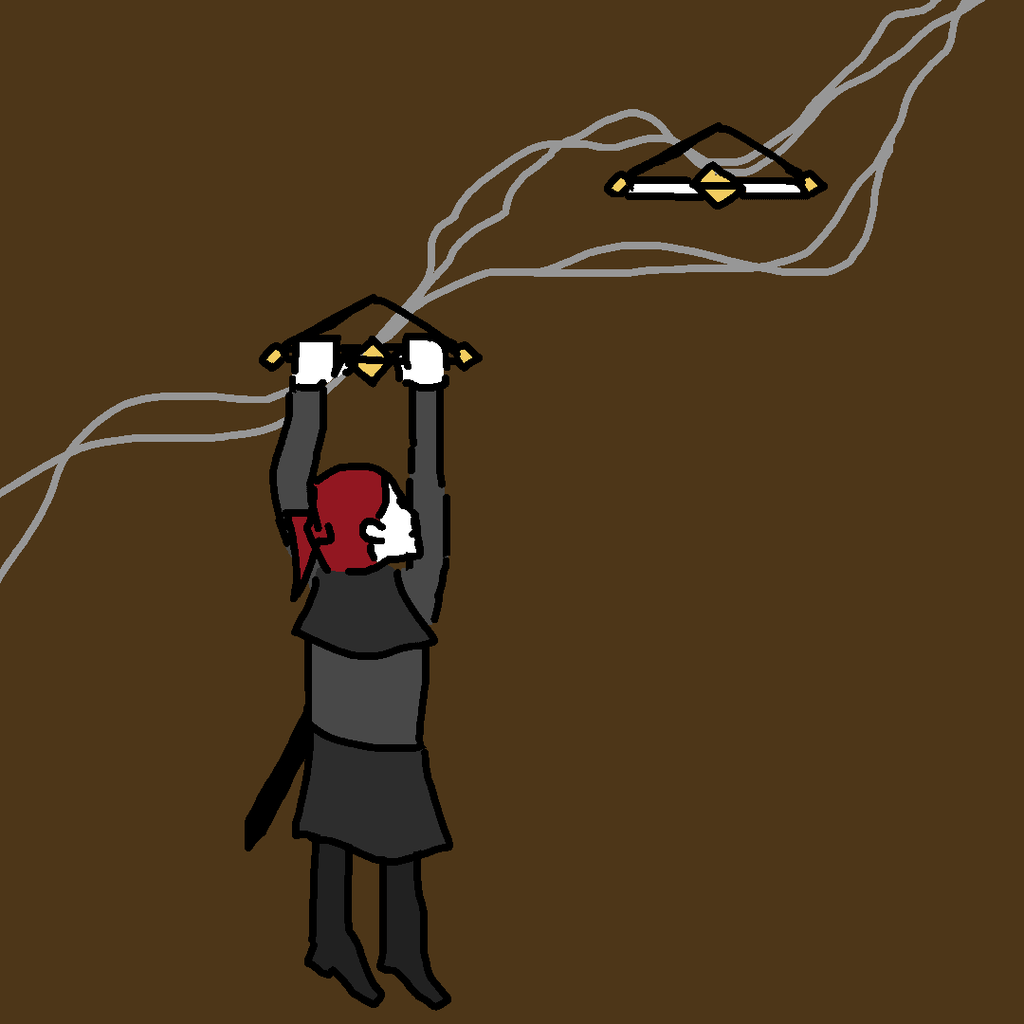
This question was spurred by a comment a peer related a professor had made to him: that there should be no link, no DOI, no internet-specific resource in a citation to a book published in physical form. What this gets at is a fundamental question as far as what the purpose of citations are for: are you furthering a long, formal tradition of “correct” citations, proving that you did the work and making a note of the footsteps you left behind?5Credit to Lena Lannutti for this metaphor. Or are you placing footholds for the researchers ascending the mountain of research behind you?
Lest you think this hypothetical is too involved, or not something that could ever happen with the legal, copyright, moral barriers: it is not entirely hypothetical, either. While I’m sure there are other examples: this hypothetical is nigh-exactly what Pulitzer Prize nominated historian Eric Cervini did with the sources for his 2021 book The Deviant’s War. With the permission of the involved archives, he transformed a physical archive into one that was completely accessible, which he named the “Deviant’s Archive.”8“The Deviant’s Archive.” The Deviant’s Archive. Accessed August 27, 2026. https://thedeviantsarchive.org/.
We can also see a parallel debate unfurl in the debate between closed and open access to published sources. Certainly, there is a long and arguably successful tradition of the publisher establishment providing access — for a price — to their journals and publications. But the internet age and the emergence of digital studies have built out infrastructure which is capable of supporting free and widespread distribution of academic knowledge. This comes in forms that are completely legal and voluntary, like the Arxiv preprint repository; ones are a mixed bag, such as SciHub, where authors will often upload their own papers to a site that is technically piracy; and fully coerced forms of access, like book repositories where entire books are uploaded without permission of the authors.
I’ll tip my hand and say that I much prefer the practical model across these topics. In the case of books, there is a monetary argument to be made — under capitalism, authors rely on book sales to make ends meet. For papers, though, there is no consequence to the author, and mandating access through publishers serves only to restrict these resources from public access. Similarly, we provide the information in our citations to make it possible to verify and build upon each other’s work — which is why we include information like the publisher, the year, the edition, the page number, none of which strictly necessary if our goal was simply to prove we did the work. Opening up our sourcing, our works, and digital humanities at large is no different.
As best I can tell, Day of Digital Humanities as a centrally organized event ceased to operate after 2024, and the survey ceased before then, so unfortunately, we cannot compare the 2011 responses to what they would be today. Give conversations with digital historians and remarks by Professor Otis, though, I doubt the proportion of exclusionists would be as big today as it was in 2011.9Jessica Marie Otis, Fall 2026 Clio Wired discussion, 24 August 2026. As Crymble remarks in Technology and the Historian, what digital humanities needs, first and foremost, is the histories, not definitions.10Crymble, Technology and the Historian, 9. The digital humanities definition wars are, hopefully, ending in the favor of the big tenters. I hope the rest of the field follows their lead.
While I am sympathetic to the view that the for-profit journals are predatory, I draw the line at Sci-Hub. Aside from outright copyright infringement, access has been blocked in enough places that it is often through mirror sites. There is at least a theoretical possibility you may end up in a dark part of the Internet you were not expecting. In any case, Internet chatter suggests that the flow of new articles has slowed over the last few years.
Hello Maddie!
Great additional analysis of the breakdown in how the digital humanities community (or at least those at the Day of Digital Humanities event) defines digital humanities. It’s helpful to know where the big debate rests – exclusionists and ‘big tenters’ – and that so many others seem to leave room for complexity. You followed up your analysis with really practical advice – as big tenters seek to expand access and belonging in the digital humanities community, there are ways in which they can do this beyond definitions. You propose intentional and thoughtful citation practices that make a digital historian’s sources and work accessible to more people and lessen rather than increase the number of hoops they have to jump through to trace and build on evidence. The Deviant’s Archive was a great example of that. I would also note that creating a website like Dr. Cervini’s and maintaining it over time is not a cheap proposition. I would add to your exhortations that our inclusive practices need to be buttressed by financial commitments – from governments, foundations, universities – to supporting access to primary sources over the long term. (Dr. Cervini could have used access to a professional scanner…)
PS: Love your website. Had never heard of Clair Obscur.
Hey Maddie! Your page looks so cool! And I love the title of this post; it’s a great hook. I also think your multimedia is great: the pie chart and digital art show a passion for the discussion. And I did recognize the Clair Obscur reference, though I haven’t played it myself (I’ve been replaying Remedy Entertainment games, gotta cram the lore for the new release!).
I think you should bring up the question of fair use in class! If there is a strict policy, I would also love to know about it. If there is no strict policy, that sounds like an interesting discussion. The links and mentions you gave of online repositories like Deviant’s Archive were really interesting. Would you consider making a page with accumulated sources like this on your website? I think it could help both you and others looking for odd and obscure sources.
I do have one small critique of the post, and that is the wording. Your argument about the big tent/exclusion camps being a proxy for greater discussions was really interesting, but it took me a few reads to understand your point. You have a lot of interesting avenues of discussion, but they get a bit lost in long sentences. Maybe try to break your argument up into a few smaller sentences, or another shorter organizational structure.
I appreciate your framework and breakdown of the camps for the foundations of DH. I also agree that Crymble’s parallel streams theory resembles capitalism too much for me, and the idea that competition will breed innovation. I know that too many cooks in the kitchen can cause problems, but having a big tent lends itself more to cooperation and shared interests, in my mind, than a group trying to hoard their ideas behind a locked door. Moreover, though our research areas may all vary, it is important that our goals are the same in the understanding of the past and not just the future, and to do so we need to be open to sharing and the free flow of ideas and data.
Продвижение веб-ресурсов — это комплекс работ, направленных на рост позиций в поисковой выдаче.
Главная задача поисковой оптимизации — продвинуть сайт на первые места поисковой выдачи по целевым запросам.
разработка сайтов
Чтобы достичь такого результата оптимизаторы проводят внутренний аудит, трудятся над содержанием, архитектурой и ссылочным профилем.
В итоге сайт делается виднее в поисковой выдаче, получает значительно больше аудитории и повышает продажи.
Ресурсы взрослой направленности призваны служить средством интимного просвещения, а также помощью в осознании собственных предпочтений.
Подобные сервисы позволяют людям изучать свои желания в безопасной обстановке, уменьшая опасность реальных последствий.
порно рассказы куколд
В отношениях совместное обсуждение подобных материалов способно укреплять взаимопонимание и становиться причиной для открытого разговора о предпочтениях и границах.
Кроме того подобные платформы предоставляют возможность для безрисковой реализации напряжения и снятия психологического напряжения, не нанося ущерба другим.