
Posted on October 8, 2026
Getting a Little Too Cute With Twine and Digital Storytelling
Posted on October 1, 2026
Some Thoughts On Maps
Or: How I Learned to Stop Worrying and Love the Herndon Shaped Hole
True story about me and maps: my dad used to lock me and my siblings individually in the computer room until we had done a set number map quizzes, because he was determined that we would love geography as much as he did.1If you’re confused by “map quiz” they were basically online quizzes where you had to identify countries/rivers/states/capital cities on a map. For reasons you might be able to imagine, this tended to have the opposite effect, but it did help me learn a lot about geography very quickly. I might not love geography and maps the way my father does, but I suppose I can at least tell you that the capital of Bosnia and Herzegovina is Sarajevo.
I suppose my point in telling you this is to say that maps and I have a bit of a complicated past. To wit, though, we should approach historical GIS with a nuanced eye. GIS is an incredibly powerful tool for studying, communication and visualization, but it also a tool that needs to be applied with care and discernment.
On Monday, in class, I used QGIS for the first time. Though the initial appearance was rather intimidating (I was reminded somewhat of the UI complexity of Blender, which I have tried and failed several times to learn), it became much easier once we identified the primary controls and started manipulating data and labels in SQL terms, something I’m much more comfortable with.
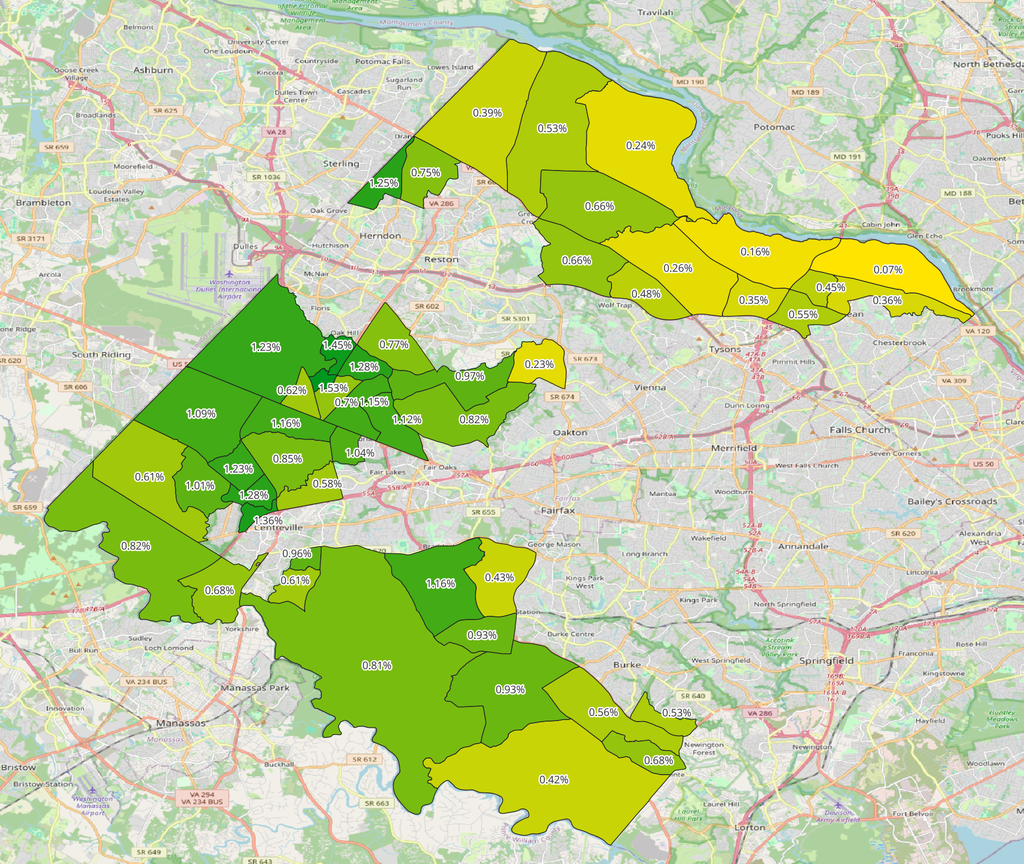
There are a number of limitations to consider when performing QGIS work, though, and a number of analytical traps to avoid. For one, humanities data is often difficult to quantify, or even incomplete. See below, where our VA-10 map is missing data to the West, creating the impression of a hole in the middle.
One weakness of QGIS I was struck by when doing this week’s readings, however, was the vulnerability of visual analysis to correlation without causation. In our reading “Beyond the Archive: What GIS Mapping Reveals about German POWs in Soviet Russia,” the Susan Grunewald acknowledges the importance of using the archives to contextualize map research, rather than using maps solely.2Susan Grunewald, “Beyond the Archives: What GIS Mapping Reveals about German POWs in Soviet Russia,” Perspectives on History, February 26, 2019.
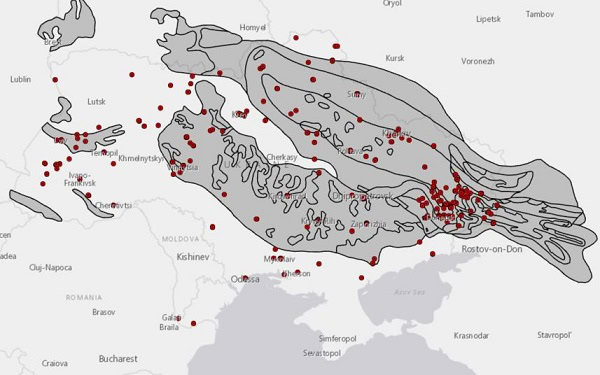
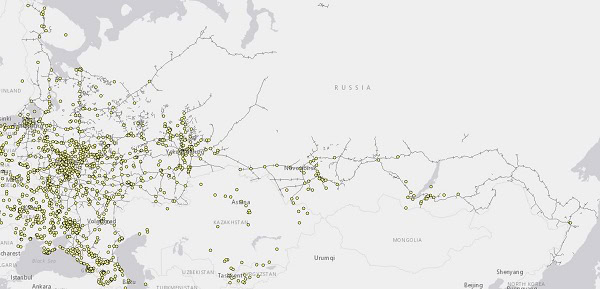
For example, in the left figure below, she writes that it shows “Over 70 percent of the camps in Ukraine, for example, were within a three-mile radius of coal basins,” but the map also shows that… well, most of Ukraine appears to be a coal basin. Fortunately, she did not make the correlation/causation mistake of this as conclusive proof that these POWs were used for labor. On the map on the right, she observes that, “An imported map of Russian rail lines showed that camps fell only on the rail networks of the Russian Soviet republic.” While this could plausibly show that workers were creating goods for transport, it could very well also be out of necessity — after all, these prisoners need to get to the camp somehow. If these maps were presented without accompanying archival evidence, I would be deeply skeptical of what they actually show.
There’s a saying in data analysis that I love, usually attributed to statistician George E. P. Box: “All models are wrong, but some are useful.” And GIS is most certainly useful. I definitely want to go back and play around more with QGIS; I was excited to find some flight data repositories that I could load in to examine airspace and airplane data through visualization. But it is a supplement, rather than definitive proof, to well reasoned and evidenced arguments. We must keep in mind Box’s wisdom: these models are wrong, and we must attend to them with care.
Posted on September 24, 2026
STEAL KNOWLEDGE! YES!!! TEN THOUSAND YEARS OF RIGHTEOUS THEFT!!!!!
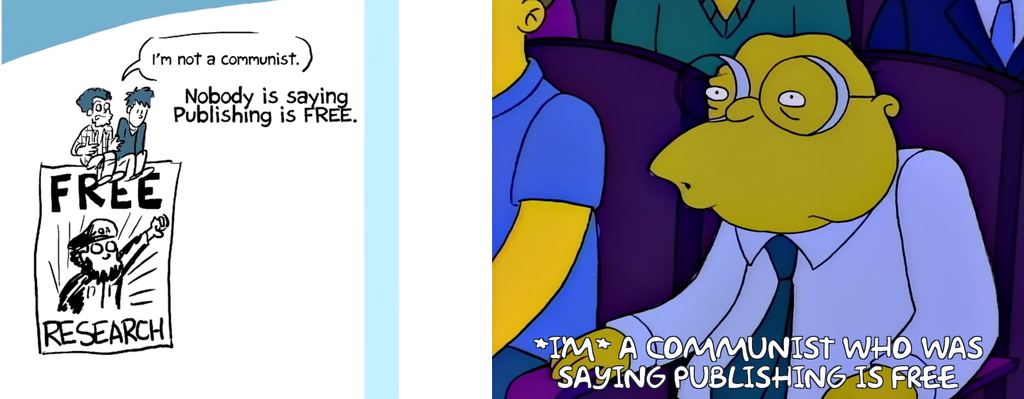
Right image: The Simpsons, season 6, episode 18, “A Star Is Burns,” directed by Susie Dietter, written by Ken Keeler, aired March 5, 1995, on Fox. Image created using http://frinkiac.com/. Text my own. Scene, for reference: https://www.youtube.com/watch?v=2Kpb8eu1pEY.
Content warning for this blog post: brief mention of suicide.
In 1859, Karl Marx published an early version of his thoughts on the labor theory of value. Marx posited that the value of profit came from stealing the value of labor, in the difference between the wage given to a worker, plus the cost of the physical goods which went into production, from the market value of the good the worker produced. We are all are free to disagree with Marx about many things — but undeniably, his theory maps horrifically well onto the way that modern academic publisheres work to steal the labor of researchers for vacuous profit. In this case, though, the researchers are not even getting paid, and in many cases, they’re the ones paying.
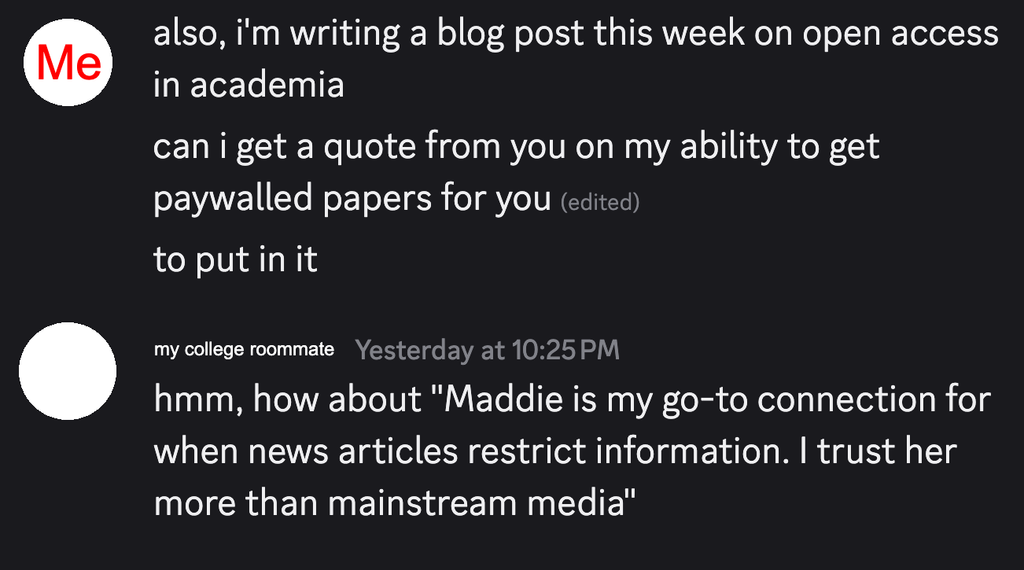
Academic publishing has been something which has long frustrated me, and to be honest, I feel very little respect for their paywalls. I’m relatively well known among my friends as the person you go to when you need to access an article.2Is this a humble brag? Probably, yes, I’m pretty proud of this reputation. Below is a screenshot of me emotionally blackmailing my college roommate into making a statement on all the scientific articles I have unlocked for them since we left undergrad (to drive home the point, they are now a science PhD student at a good university, and still sometimes need to come to me for help with access).
Shall we walk through the steps in modern academic publishing? The Vox article “The war to free science: How librarians, pirates, and funders are liberating the world’s academic research from paywalls” already did a version of this, and an excellent one in comparing the function of a publishing company to a government, but I think it’s worth running through the steps nonetheless as an exercise in visualizing the current futility of academic publishing.3Resnick, Brian, and Julia Belluz. “The War to Free Science: How Librarians, Pirates, and Funders Are Liberating the World’s Academic Research from Paywalls.” Vox, July 10, 2019.
First, a research question is devised. A researcher, somewhere, puts in the work, finds a gap in the literature, and decides to research it.
Over the course of weeks, months, years — the researcher puts in the work. The work is funded by some combination of the researcher themselves, the university, the government, and other grants.
The researcher writes a paper, and sends it off to a publisher for publication! Hurrah, the publisher is finally going to do some work!
But no, instead, rather than trying to judge the paper themselves, the publisher sends it off to peer reviewers. Are the peer reviewers compensated for their work? Of course not.
Finally, the paper is ready for publication. Surely the publisher will have to put in some real work here, right? Or at least, some material. But no — almost no academic journals still publish physical volumes. Instead, they hit publish, placing the document on a database somewhere, and a short entry on it on a portal somewhere. Looking at my hard drive, it seems an average academic paper runs from 100 KB all the way up to 1 MB. What are the rates are on AWS for 1 MB of storage? Standard storage rate is $0.0265 per GB-month, which from some quick back of the napkin math means that the rate for one academic paper is approximately… 2.65 * 10-5 dollars per month. Yep, that’s right, had to break out the scientific notation for that one. That’s a two thousanths of a cent, for those keeping track at home. You could hit 50,000 papers before you hit a dollar per month.
So no, publishers are not providing material benefit to their ecosystem to justify their exorbitant rates. The rates are exorbitant – I checked one of my own publications and it it would cost $32 to access. In a move that seems almost downright satirical, you can also choose to publish your article for open access in this journal for the low, low price of $3500. And these prices do real damage to the academic ecosystem. The PhD Comics video did a good job of exemplifying one type of material harm, but it also makes academic writing something exclusive, that the public can’t access!4Piled Higher and Deeper (PHD Comics). “Open Access Explained!” In an era where trust in science is at a low point, in one where pseudoscientific grifts are doing real harm through the internet, there is real harm of keeping our research from the public — and that’s besides the point that publishers want their research out there!
I realize that this is the second or third time in just four blog posts that I have brought up Aaron Swartz, but I think this blog post in particular, on copyright and open access, would be the right time to go into his story, rather than just mention him offhandedly.
I’ve been fixated on Swartz’s case for many years at this point, maybe because I can’t help but project myself onto him when I read his story. That’s not to compare my ability to his — Swartz was as close to they come as a real kid genius, who at the age of 13 contributed to the creation of RSS, a technology still used to this day. He was, to the extent that I believe this is a real thing, a once in a generation computer science talent. I’m a decent programmer, but I am certainly not on that level. I see another awkward, queer kid, though, who loved computers and learning and open information and can’t help but relate.5Swartz might reject the more modern label of queer — though he openly had relationships with both men and women, he rejected the labels “gay” and “bisexual” as unnecessary to define his sexual identity (something I happen to generally agree with). See Swartz, Aaron. “Why I Am Not Gay.” Raw thought, September 8, 2009. http://www.aaronsw.com/weblog/notgay.
Swartz would die young, at age 26. He was charged with 13 federal crimes, threatened with up to 50 years in prison, when he decided to die by suicide. You may find yourself asking what the crime was, and I will tell you: he downloaded articles that he had access to from JSTOR. Using a script and his legal access to JSTOR, he downloaded several thousand academic articles. Prosecutors alleged he intended to upload them to open access sites, and to their credit, he probably did. But he was prosecuted to oblivion for, at the end of the day, downloading files he had legal access to download.
There are no excuses for the prosecution of Swartz. In the prosecution of a crime in which nobody was hurt but some potential shareholder value, a brilliant coder and human died. It infuriates me to this day, and it exemplifies how copyright is often utilized as a bourgeois institution, working on behalf of publishers rather than the actual authors. So yes, in spite of copyright, and in memory of people like Aaron Swartz, you should steal knowledge from academic publishers. Knowledge is nobody’s to own, and everyone’s to learn. Download that paper for free, or upload one that you have access to. In class, we were asked whether librarians and academics were “pro-piracy”. I can’t speak for anyone besides myself, but I say: if they’re not, they should be.
Posted on September 17, 2026
Project Management Doesn’t Need Frameworks: It Needs Structure
When discussing the definition of digital history in his 2021 book Technology and the Historian, Adam Crymble found himself skeptical of the utility of continued confabulation over the precise definition of the term “digital humanities,” writing, “Digital history does not need definitions. It needs histories.”1Crymble, Adam, Technology and the Historian: Transformations in the Digital Age (University of Illinois Press, 2021; online edn, Illinois Scholarship Online, 23 Sept. 2021), https://doi.org/10.5622/illinois/9780252043710.001.0001, accessed 12 Aug. 2026, 161. After our discussion and exercises in Clio Wired this week, and with the benefit of a background in software development, I find myself in a similar position with regards to the continued advancement of frameworks of project management and communication: what we need isn’t frameworks, but tools and structures. In slightly Marxist terms, praxis over theory.
I suppose I should start by refining what I mean in the difference between a structure and a framework, which are pretty similar terms. By framework, I’m talking about a theoretical framework, a high level conceptual idea of a way to conceive of project mangement; the same way it is used in Edin Tabak’s 2017 paper “A Hybrid Model for Managing DH Projects.”2Tabak, Edin. “A Hybrid Model for Managing DH Projects.” Digital Humanities Quarterly 11, no. 1 (2017). https://doi.org/10.63744/rme2max8ep42. In contrast, a structure is a specific plan for managing a specific project. For example: we have standup on Tuesdays and Thursdays; we store documentation in an Atlassian wiki; our files are named [subject]-[author]-[date].[file], etc..
For a little background on where I’m coming from, I have worked for four years in software development and engineering. I gained most of my experience working on a development team engineering cybersecurity software for Verizon. This team’s structure spared me the worst of the agile/scrum environments in what my developer lead called “Agile-lite”. But I also work with other teams who are working under a much more stringent interpretation of the agile/scrum framework – and, to what I imagine is no surprise to anyone who has ever worked under one of these frameworks, my team was far more efficient, even while being one of the largest teams on the project and at my company.
The real difference maker here was not the difference between frameworks but in the details of the implementation of a structure. My teams have historically not adhered well to exactly what is perscribed by Scrum – we’ve often had no dedicated project managers, standup only as needed, planning around releases rather than sprints. The reason the team succeeded in this looser adoption of a framework was by making up for it with strong structure, an understanding of who and where information could be found, what needed to be done and when. Our team centered on mutual trust to be able to get things done and was based around quickly access to information and remove roadblocks, in order to reduce time spent planning and increase spent time in development. In addition to an active Slack with well-divided channels to divide out topics of communication, one example of this structure at work was in our daily standups. The main check we made in these meetings was for “issues or blockers,” that is, any problems you ran into or things that would prevent you from finishing your tickets, and if one was present we would work to remove it then and there.
![STOP DOING AGILE
SOFTWARE WAS NOT SUPPOSED TO BE SISYPHEAN
YEARS OF PROGRAMS yet NO REAL-WORLD USE FOUND for a DAILY STANDUP
Wanted to add features anyway for a laugh? We had a tool for that: It was called "WATERFALL"
"Yes please give me UNFINISHED software. Please let me work INFINITY hours"- Statements dreamed up by the utterly Deranged
LOOK at what Programmers have been demanding your Respect for all this time, with all the keyboards & mice we built for them
(This is REAL PROGRAMMING, done by REAL Programmers):
[Three diagram images, each captioned with "?????", "???????", and "????????????????" respectively]
"Hello I would like ⭕ features please"
They have played us for absolute fools](https://madelynharrington.net/wp-content/uploads/2026/09/babe-its-4-pm-time-to-roll-the-boulder-back-up-the-hill-v0-6fVbLL78u_Ka2fb-Gx6qVuOU6pt1xvtK42myoDOr4GM.webp)
I’ve also seen a number of other projects, both ones I have been on and ones I have witnessed from the outside, fail organizationally, with consequences ranging from companies folding, to delays, to simply excess stress on developers. As exemplified by our exercise on implementing an imaginary application for a Digital Humanities Advancement Grant, there is a wide array of different aspects that must be managed within a project, and keeping them all together is no small task.4National Endowment for Humanities, “Digital Humanities Advancement Grants Notice of Funding Opportunity” (2024) https://www.neh.gov/sites/default/files/inline-files/20240111-HAA%20Digital%20Humanities%20Advancement%20Grants%202024%20%281%29.pdf. I appreciate where Tabak is coming from when he attempts to iterate on frameworks for both communication and project management, as many of these failures do often come down to failures in communication. But to his point, because DH projects involve non-linear workflows and diverse stakeholders, the need for a reliable, localized structure is even more pressing than in standard software dev, and I struggle to see how Tabak’s proposed framework is more useful in addressing this problem than encouraging teams to use better tools and providing them with structural practices.
It can certainly be helpful for scholarship to construe projects in the abstract; even in writing this, I’m feeling the problem that it’s hard to extrapolate a lesson from structure out to a wider lesson. But in my experience every team is different, and improving project management comes down to knowing your team, both collectively and individually; knowing your stack; and knowing your problem. It’s something no framework can replicate, because it comes down to being able to adapt to the needs of your project and the individuals on your team, something Tabak touches on when he delves into what makes DH projects unique from digital projects writ large.
I was reminded of this while working with my group in planning the first stage of our final project. Though we had a productive discussion on the benefits of the frameworks of project management and communication discussed in the readings, once we began to discuss the project, it was fully anchored in what tools and communication styles were beneficial for us, rather than anything based in theory. All in all, I’m very excited to get started on this project, and to see how we can manage our project as the semester goes on!
Posted on September 3, 2026
Making a One-Sided Case for Digitization
Digitization is awesome and its issues are solvable
During our HIST 696 class this week, we discussed the advantages and disadvantages of source digitization.1I know we also talked about AI and if I don’t talk about AI in this blog post it will be the second week in a row I focus on the theory portion of class rather than practice. But I plead your sympathy. My background is in tech and I have already had a lifetime’s worth of AI discussions. I cannot bring myself to willingly talk about AI for an entire blog post. I found myself a little surprised that the discussion focused mostly on the disadvantages, though I suppose this might have something to do with the arguments against digitization are less obvious and more interesting than the arguments for digitization. As Blaney and Siefring discussed in their paper “A Culture of Non-Citation,” there still remains a persistent culture of sentiments against digital sources in the humanities, and so it is important that we also remember the positives of this process.2Blaney, Jonathan, and Judith Siefring. “A Culture of Non-Citation: Assessing the Digital Impact of British History Online and the Early English Books Online Text Creation Partnership.” Digital Humanities Quarterly 11, no. 1 (December 1, 2016). https://doi.org/10.63744/rme2max8ep42.
Therefore, for the sake of laying it all out, though, I decided I wanted to write about a few reasons I love digitization, and how our discussions of its limitations can be used to inform solutions to those problems.
#1: History is for everybody
In Sarah Maza’s 2017 book Thinking About History, she notes that history is one of the only academic fields which still consistently has laymen operating at its highest levels. As Maza notes, the Pulitzer Prize for history has gone to number of people without history degrees in the 21st century alone, including English professors, journalists and bankers.3Maza, Sarah. Thinking About History. United Kingdom: University of Chicago Press, 2017, 2. It’s a beautiful fact about history, and as digital history is increasingly something accessible to research and contribution by the general public via blogs, Wikipedia, and social media, the benefits of digitization for our field will only multiply.
Keep in mind – digitization covers more than just primary sources! Under the umbrella of source digitalization we can digitize secondary sources and tertiary sources to allow for even greater access to the humanities among everyday people.4Yes, technically, if you want to go by the book, you may be limited by copyright here. But also, long live Aaron Swartz.
#2: The vast majority of sources are easily digitizable
One argument that came up in class against digitization is that there are many sources that digitize poorly. Lena brought up a fascinating example of a collection she had worked on, where the pictures available failed to show that the objects emitted light! It’s a fascinating example of an area where a simple picture fails to tell the whole story of an interesting historical object.
The vast majority of our sourcing as historians, though, digitizes much better. How often when reading a history text do you see a physical object being cited rather than an archival paper, an image, even a video or audio piece, all of which transfer smoothly to digital versions?5Surprisingly, I cannot find any statistics on this. Between written documents/images/video/audio, surely it’s greater than 99% of citations though, right? Let me know what you think. And yes, you lose certain aspects of a document – its feel, its smell, its weight, its size – by not being able to touch it, but only rarely do factors like these make it into the final product. There’s a reason historians spend so much time in archives taking pictures, and less reading sources. And besides, when we do feel the urge to go into the archives:
#3: Digital sourcing has a very low opportunity cost
For that small percentage of sources, which do not digitize well, digitization does not need to tell the whole picture. One of the advantages of digitizing is allowing researchers to find the sources they need, and this is where our discussion of metadata comes in. Metadata can inform researchers both that a piece of data exists, and a good description can help inform a decision to come into the archives and take a look themselves.
Digital hosting is (relatively) cheap, with robust databases available at prices in the range of just hundreds of dollars per year, which isn’t even considering the fact that most institutions already pay for some form of hosting. If all digital sourcing does is tell someone they need to check out an archive, it has achieved something positive at very low opportunity cost.
#4: We can build out infrastructure to solve many problems
I found the example Zine from Michelle Moravec’s article to be a very interesting example of a problem we could theoretically mostly solve by building out better infrastructure.6Moravec, Michelle. “What Would You Do? Historians’ Ethics and Digitized Archives.” On Archivy, April 14, 2016. https://medium.com/on-archivy/on-april-at-the-organization-of-american-historians-i-participated-in-a-roundtable-discussion-563213dc94a. Beyond taking cues from other fields, like journalism, and potentially censoring the name, or reaching out the subject (if they are alive) to ask for their preferences, there are technical methods for obscuring objects like the hypothetical zine from people who are not coming to the archive for research. For example, all major search engines respect robots.txt or <meta name=”robots” content=”noindex”> tags to instruct them not to index a certain page in their results. For crawlers or LLMs, it’s reasonable to be concerned that bad faith actors may ignore agreed upon technical standards.7Shilov, Anton. “Several AI Companies Said to Be Ignoring Robots Dot Txt Exclusion, Scraping Content without Permission: Report.” Tom’s Hardware, June 21, 2024. https://www.tomshardware.com/tech-industry/artificial-intelligence/several-ai-companies-said-to-be-ignoring-robots-dot-txt-exclusion-scraping-content-without-permission-report. We still have a technical solution, though! Captcha-like gates, which completely block off a page from loading on the server layer until a challenge is solved, can prevent sensitive data from being seized. Even simply locking the content behind account creation is a simple way of defeating automated threats.8The reason I say Captcha-like instead of just Captcha is that LLM browser agents are steadily getting better at defeating captchas, and we’ll need better ways to defeat them soon. If you’re interested, here’s a good paper on it: Ousat, Behzad, Nikita Turkmen, Lalchandra Rampersaud, Dillan Bailey, and Amin Kharraz. 2026. “Broken Gates: Re-Evaluating Web Bot Defenses in the Age of LLM Agents.” Version 1. Preprint, arXiv. https://doi.org/10.48550/ARXIV.2607.18659.
In class it was brought up that digital sources can degrade – and this is simply another issue of inadequate digital humanities architecture. The example brought up in class was lossy compression, which in general should not be something and archive has to worry about, as images should be getting re-compressed regularly, but to the extent changes are made to an image and it is recompressed, this is what diff-centric architecture is for. Git has been an industry standard for some time for tracking versions, and something which we can easily implement to cheaply track file versions across an archive.9For those unfamiliar/curious: https://en.wikipedia.org/wiki/Git Community based resources such as the Internet Archive and open source VM-emulators are also constantly being improved in order to help address other types of potential digital source degradation, namely link rot and digital obsolescence.
And no, digitization is not perfect. S.L. Ziegler is right when they note that we must be cognizant of how we use data from people in the past, as to not become “grimy.”10Ziegler, S.L. “Open Data in Cultural Heritage Institutions: Can We Be Better than Data Brokers?” Digital Humanities Quarterly 14, no. 2 (June 19, 2020). https://doi.org/10.63744/jfyb9zym5am3. Beyond that, it takes a great deal of labor to digitize a database, labor which we must not take for granted. But the downsides that are present in digitization are mitigable, and it’s good to remember that when we discuss the potential threats to digitization, we do so to refine better methods and practices, not to discourage the practice altogether.
Posted on August 27, 2026
The Big “Big Tent” Debate
Big tenters vs. exclusionists everywhere!
In his 2021 book Technology and the Historian, Adam Crymble explores the history of the perennial debate surrounding how exactly we should define the term “digital history,” and its closely related if not outright identical sibling “digital humanities.”1Crymble, Adam, Technology and the Historian: Transformations in the Digital Age (University of Illinois Press, 2021; online edn, Illinois Scholarship Online, 23 Sept. 2021), https://doi.org/10.5622/illinois/9780252043710.001.0001, accessed 12 Aug. 2026, 5-7. Crymble presents a framework of three models of digital humanities definitions:
- The “exclusive” model which attempts to gatekeep digital humanities to certain methods or signifiers of “real” digital history.
- The “big tent” model, which includes, broadly, anything which would like to call itself digital humanities or anything roughly involving a humanities study and a computer.
- Crymble’s own, preferred, “parallel streams” model, which contends that technology and historical studies have always evolved in parallel and interact with each other across many different intersections.2Crymble, Technology and the Historian, 163.
Crymble seems to make a strong enough case for his parallel streams model, but for our purposes, I’m not too interested in it. Even Crymble himself is not so interested in continuing this debate, and indeed, his model is as much a method of bypassing the debate in order to do scholarship on the subject as it is a cohesive definition.3Crymble, Technology and the Historian, 161. What I am interested in exploring is how the divide in mindset of the “big tenters” and “exclusionists” permeates throughout other aspects of digital history.
In the introduction, Crymble cites a running open survey done by the Day of Digital Humanities event, in which participants were asked to define what they thought digital humanities meant. Thanks to the University of Alberta’s archive, we can see these responses in raw form.4“How Do You Define Humanities Computing / Digital Humanities?” University of Alberta Archive. Accessed August 27, 2026. https://archive.artsrn.ualberta.ca/day-of-dh/define-dh.html. The responses are a fascinating snapshot:
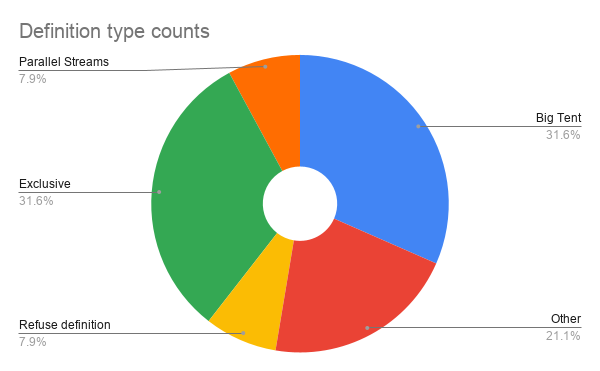
A few observations about this: for one, while a few offered a definition akin to Crymble’s “parallel streams” model, an equivalent number outright refused to answer the question. Additionally, a solid fifth of the respondents offered a definition which I could not neatly fit into any of Crymble’s boxes. Most importantly though, it visualizes for us the divide between “big tenters” and “exclusionists” as the primary division at play.
What I find interesting about this divide is the extent to which it serves as a proxy as a debate between two competing views which have reach into digital humanities beyond simply defining the subject, wherein they also serve as a philosophical boundary in how we construe the purpose of technology in our studies. On the one hand, the exclusionists represent a traditionalist, even formalist view, where academics represent a long tradition of study and formal principles from the Ivory Tower which must be upheld. On the other, “big tenters” represent an approach that is practicalist, with the purpose of academia being a no-holds-barred fight for knowledge. From this principle, the big tent principle of definitions of digital humanities based on self-identification follows naturally.
This divide pervades more widely than simply the precise definition of digital humanities. As an example, let me lay out a hypothetical for you. You have gone to do research at an archive, and they told you that not only were you free to take pictures of the sources you were using, but copyright was no issue, and there were no legal barriers to posting such sources online. Furthermore, everyone involved was long dead, and there was therefore no risk of putting someone in danger by making these documents more accessible. Would it therefore be correct, to post these sources online and provide a links to these sources in your citations?
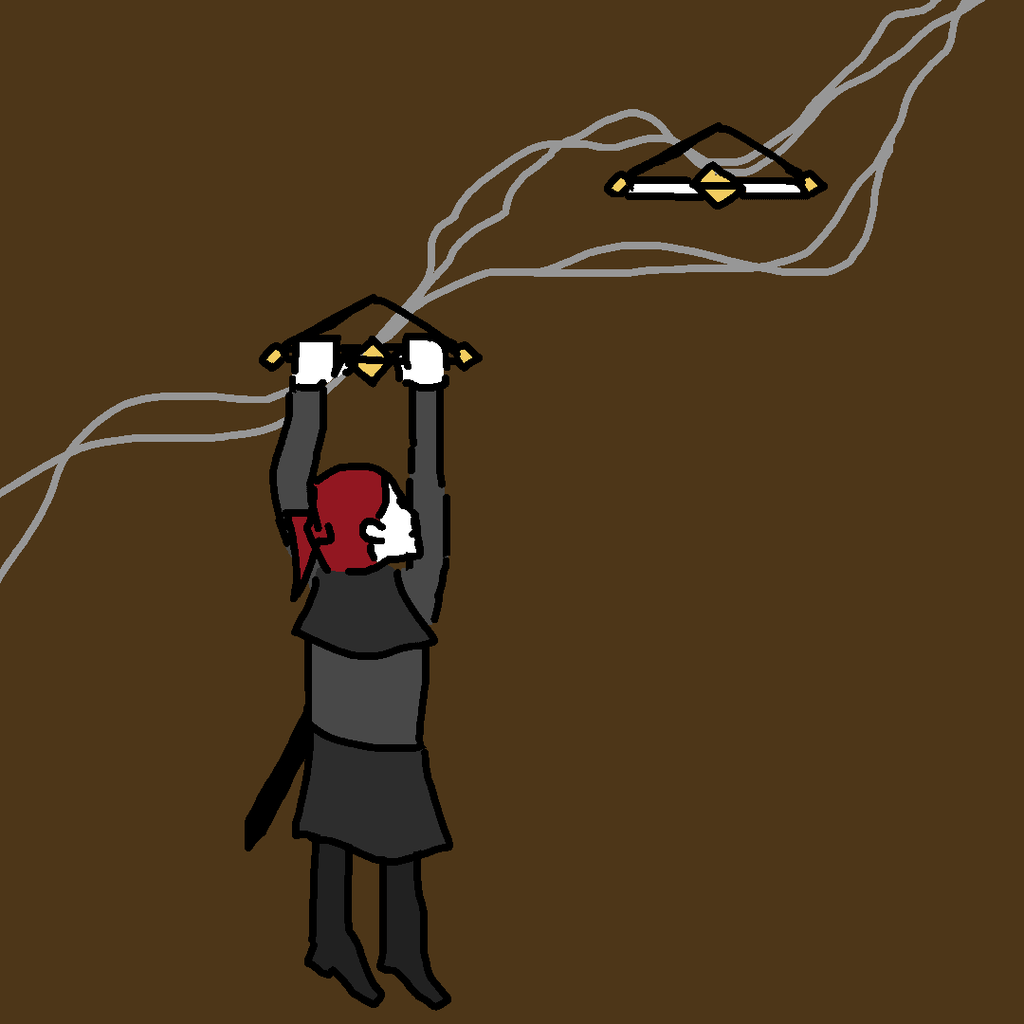
This question was spurred by a comment a peer related a professor had made to him: that there should be no link, no DOI, no internet-specific resource in a citation to a book published in physical form. What this gets at is a fundamental question as far as what the purpose of citations are for: are you furthering a long, formal tradition of “correct” citations, proving that you did the work and making a note of the footsteps you left behind?5Credit to Lena Lannutti for this metaphor. Or are you placing footholds for the researchers ascending the mountain of research behind you?
Lest you think this hypothetical is too involved, or not something that could ever happen with the legal, copyright, moral barriers: it is not entirely hypothetical, either. While I’m sure there are other examples: this hypothetical is nigh-exactly what Pulitzer Prize nominated historian Eric Cervini did with the sources for his 2021 book The Deviant’s War. With the permission of the involved archives, he transformed a physical archive into one that was completely accessible, which he named the “Deviant’s Archive.”8“The Deviant’s Archive.” The Deviant’s Archive. Accessed August 27, 2026. https://thedeviantsarchive.org/.
We can also see a parallel debate unfurl in the debate between closed and open access to published sources. Certainly, there is a long and arguably successful tradition of the publisher establishment providing access — for a price — to their journals and publications. But the internet age and the emergence of digital studies have built out infrastructure which is capable of supporting free and widespread distribution of academic knowledge. This comes in forms that are completely legal and voluntary, like the Arxiv preprint repository; ones are a mixed bag, such as SciHub, where authors will often upload their own papers to a site that is technically piracy; and fully coerced forms of access, like book repositories where entire books are uploaded without permission of the authors.
I’ll tip my hand and say that I much prefer the practical model across these topics. In the case of books, there is a monetary argument to be made — under capitalism, authors rely on book sales to make ends meet. For papers, though, there is no consequence to the author, and mandating access through publishers serves only to restrict these resources from public access. Similarly, we provide the information in our citations to make it possible to verify and build upon each other’s work — which is why we include information like the publisher, the year, the edition, the page number, none of which strictly necessary if our goal was simply to prove we did the work. Opening up our sourcing, our works, and digital humanities at large is no different.
As best I can tell, Day of Digital Humanities as a centrally organized event ceased to operate after 2024, and the survey ceased before then, so unfortunately, we cannot compare the 2011 responses to what they would be today. Give conversations with digital historians and remarks by Professor Otis, though, I doubt the proportion of exclusionists would be as big today as it was in 2011.9Jessica Marie Otis, Fall 2026 Clio Wired discussion, 24 August 2026. As Crymble remarks in Technology and the Historian, what digital humanities needs, first and foremost, is the histories, not definitions.10Crymble, Technology and the Historian, 9. The digital humanities definition wars are, hopefully, ending in the favor of the big tenters. I hope the rest of the field follows their lead.