
Posted on September 24, 2026
STEAL KNOWLEDGE! YES!!! TEN THOUSAND YEARS OF RIGHTEOUS THEFT!!!!!
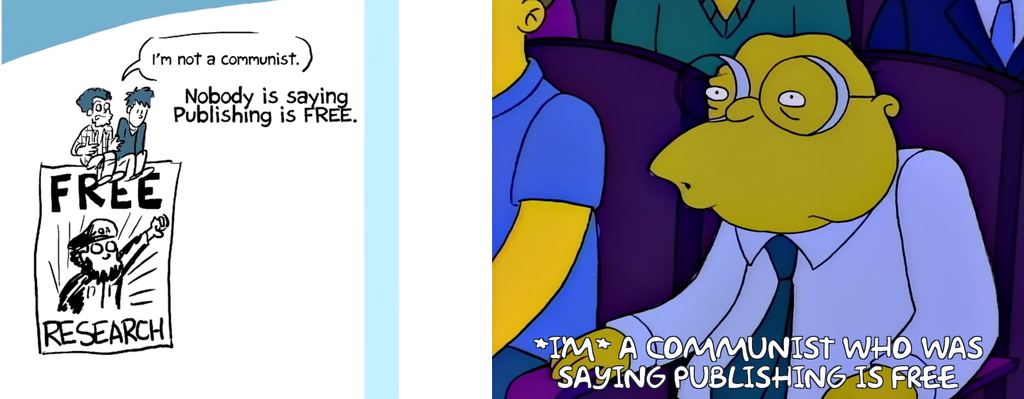
Right image: The Simpsons, season 6, episode 18, “A Star Is Burns,” directed by Susie Dietter, written by Ken Keeler, aired March 5, 1995, on Fox. Image created using http://frinkiac.com/. Text my own. Scene, for reference: https://www.youtube.com/watch?v=2Kpb8eu1pEY.
Content warning for this blog post: brief mention of suicide.
In 1859, Karl Marx published an early version of his thoughts on the labor theory of value. Marx posited that the value of profit came from stealing the value of labor, in the difference between the wage given to a worker, plus the cost of the physical goods which went into production, from the market value of the good the worker produced. We are all are free to disagree with Marx about many things — but undeniably, his theory maps horrifically well onto the way that modern academic publisheres work to steal the labor of researchers for vacuous profit. In this case, though, the researchers are not even getting paid, and in many cases, they’re the ones paying.
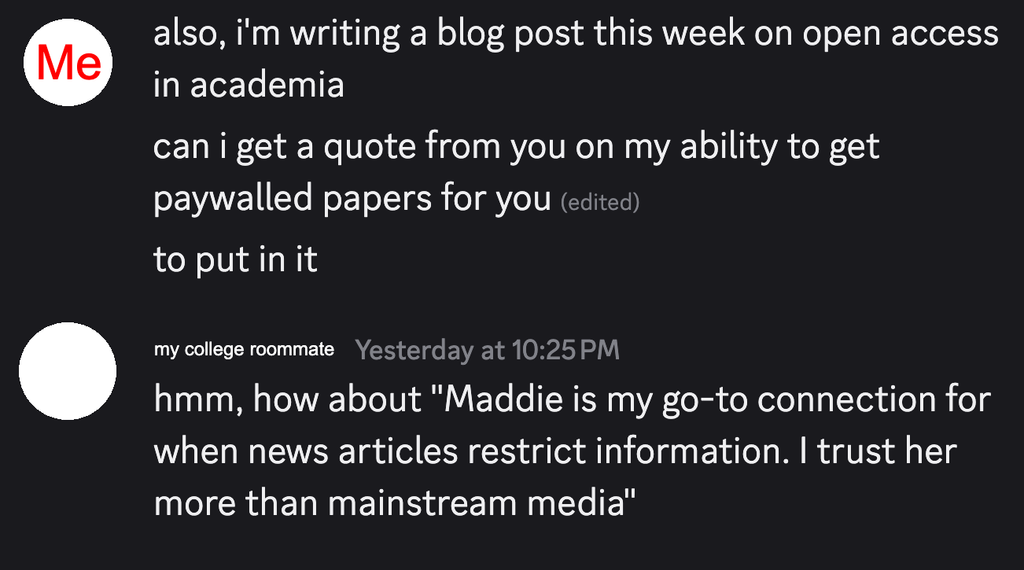
Academic publishing has been something which has long frustrated me, and to be honest, I feel very little respect for their paywalls. I’m relatively well known among my friends as the person you go to when you need to access an article.2Is this a humble brag? Probably, yes, I’m pretty proud of this reputation. Below is a screenshot of me emotionally blackmailing my college roommate into making a statement on all the scientific articles I have unlocked for them since we left undergrad (to drive home the point, they are now a science PhD student at a good university, and still sometimes need to come to me for help with access).
Shall we walk through the steps in modern academic publishing? The Vox article “The war to free science: How librarians, pirates, and funders are liberating the world’s academic research from paywalls” already did a version of this, and an excellent one in comparing the function of a publishing company to a government, but I think it’s worth running through the steps nonetheless as an exercise in visualizing the current futility of academic publishing.3Resnick, Brian, and Julia Belluz. “The War to Free Science: How Librarians, Pirates, and Funders Are Liberating the World’s Academic Research from Paywalls.” Vox, July 10, 2019.
First, a research question is devised. A researcher, somewhere, puts in the work, finds a gap in the literature, and decides to research it.
Over the course of weeks, months, years — the researcher puts in the work. The work is funded by some combination of the researcher themselves, the university, the government, and other grants.
The researcher writes a paper, and sends it off to a publisher for publication! Hurrah, the publisher is finally going to do some work!
But no, instead, rather than trying to judge the paper themselves, the publisher sends it off to peer reviewers. Are the peer reviewers compensated for their work? Of course not.
Finally, the paper is ready for publication. Surely the publisher will have to put in some real work here, right? Or at least, some material. But no — almost no academic journals still publish physical volumes. Instead, they hit publish, placing the document on a database somewhere, and a short entry on it on a portal somewhere. Looking at my hard drive, it seems an average academic paper runs from 100 KB all the way up to 1 MB. What are the rates are on AWS for 1 MB of storage? Standard storage rate is $0.0265 per GB-month, which from some quick back of the napkin math means that the rate for one academic paper is approximately… 2.65 * 10-5 dollars per month. Yep, that’s right, had to break out the scientific notation for that one. That’s a two thousanths of a cent, for those keeping track at home. You could hit 50,000 papers before you hit a dollar per month.
So no, publishers are not providing material benefit to their ecosystem to justify their exorbitant rates. The rates are exorbitant – I checked one of my own publications and it it would cost $32 to access. In a move that seems almost downright satirical, you can also choose to publish your article for open access in this journal for the low, low price of $3500. And these prices do real damage to the academic ecosystem. The PhD Comics video did a good job of exemplifying one type of material harm, but it also makes academic writing something exclusive, that the public can’t access!4Piled Higher and Deeper (PHD Comics). “Open Access Explained!” In an era where trust in science is at a low point, in one where pseudoscientific grifts are doing real harm through the internet, there is real harm of keeping our research from the public — and that’s besides the point that publishers want their research out there!
I realize that this is the second or third time in just four blog posts that I have brought up Aaron Swartz, but I think this blog post in particular, on copyright and open access, would be the right time to go into his story, rather than just mention him offhandedly.
I’ve been fixated on Swartz’s case for many years at this point, maybe because I can’t help but project myself onto him when I read his story. That’s not to compare my ability to his — Swartz was as close to they come as a real kid genius, who at the age of 13 contributed to the creation of RSS, a technology still used to this day. He was, to the extent that I believe this is a real thing, a once in a generation computer science talent. I’m a decent programmer, but I am certainly not on that level. I see another awkward, queer kid, though, who loved computers and learning and open information and can’t help but relate.5Swartz might reject the more modern label of queer — though he openly had relationships with both men and women, he rejected the labels “gay” and “bisexual” as unnecessary to define his sexual identity (something I happen to generally agree with). See Swartz, Aaron. “Why I Am Not Gay.” Raw thought, September 8, 2009. http://www.aaronsw.com/weblog/notgay.
Swartz would die young, at age 26. He was charged with 13 federal crimes, threatened with up to 50 years in prison, when he decided to die by suicide. You may find yourself asking what the crime was, and I will tell you: he downloaded articles that he had access to from JSTOR. Using a script and his legal access to JSTOR, he downloaded several thousand academic articles. Prosecutors alleged he intended to upload them to open access sites, and to their credit, he probably did. But he was prosecuted to oblivion for, at the end of the day, downloading files he had legal access to download.
There are no excuses for the prosecution of Swartz. In the prosecution of a crime in which nobody was hurt but some potential shareholder value, a brilliant coder and human died. It infuriates me to this day, and it exemplifies how copyright is often utilized as a bourgeois institution, working on behalf of publishers rather than the actual authors. So yes, in spite of copyright, and in memory of people like Aaron Swartz, you should steal knowledge from academic publishers. Knowledge is nobody’s to own, and everyone’s to learn. Download that paper for free, or upload one that you have access to. In class, we were asked whether librarians and academics were “pro-piracy”. I can’t speak for anyone besides myself, but I say: if they’re not, they should be.
Maddie, you provide a lot of insight and your personal experiences into your analysis of the barriers publishers place on scholarly access. Before reading your post, I had not heard of the programmer Aaron Swartz and the controversy around his actions was shocking! It showcases the harm that can happen when items are paywalled, like the situation mentioned in the Piled High and Deep video
Hi Maddie,
You make an extremely well-argued case for the problems of the current state of academic publishing. I agree; publishing paywalls are reaching exorbitant rates that are unrealistic for a professional academic to pay, much less for the average person. With the number of claims made on the internet each day, it’s becoming more important to ensure that people have unhindered access to scientific, peer-reviewed, and legitimate sources on their own, independent of any interpretive commentary.
Resnick and Belluz’ article especially struck me; as someone generally unversed in academic publishing, I didn’t realize journal peer reviewers were not compensated for their time and labor. The way you’ve laid out the timeline of academic publishing, pointing out how publishers don’t actually fork over that much money at ANY point in the process (including for server space!), only further illuminates how inane their high paywalls are.